The Banu Musa’s Ingenious Devices: Water, Valves and Automatic Control
Inside the Banu Musa brothers’ ninth-century Book of Ingenious Devices: self-regulating vessels, clever valves, changing fountains and the logic behind them.
Around the middle of the ninth century, three scholarly brothers active in Abbasid Baghdad—Muhammad, Ahmad and al-Hasan ibn Musa ibn Shakir—compiled the Kitab al-Hiyal, or Book of Ingenious Devices. Known collectively as the Banu Musa, they moved in a courtly world of mathematics, astronomy, translation and instrument making. Their illustrated text presents roughly one hundred devices, especially vessels, fountains, lamps and mechanisms that control liquids or create an apparently surprising response.
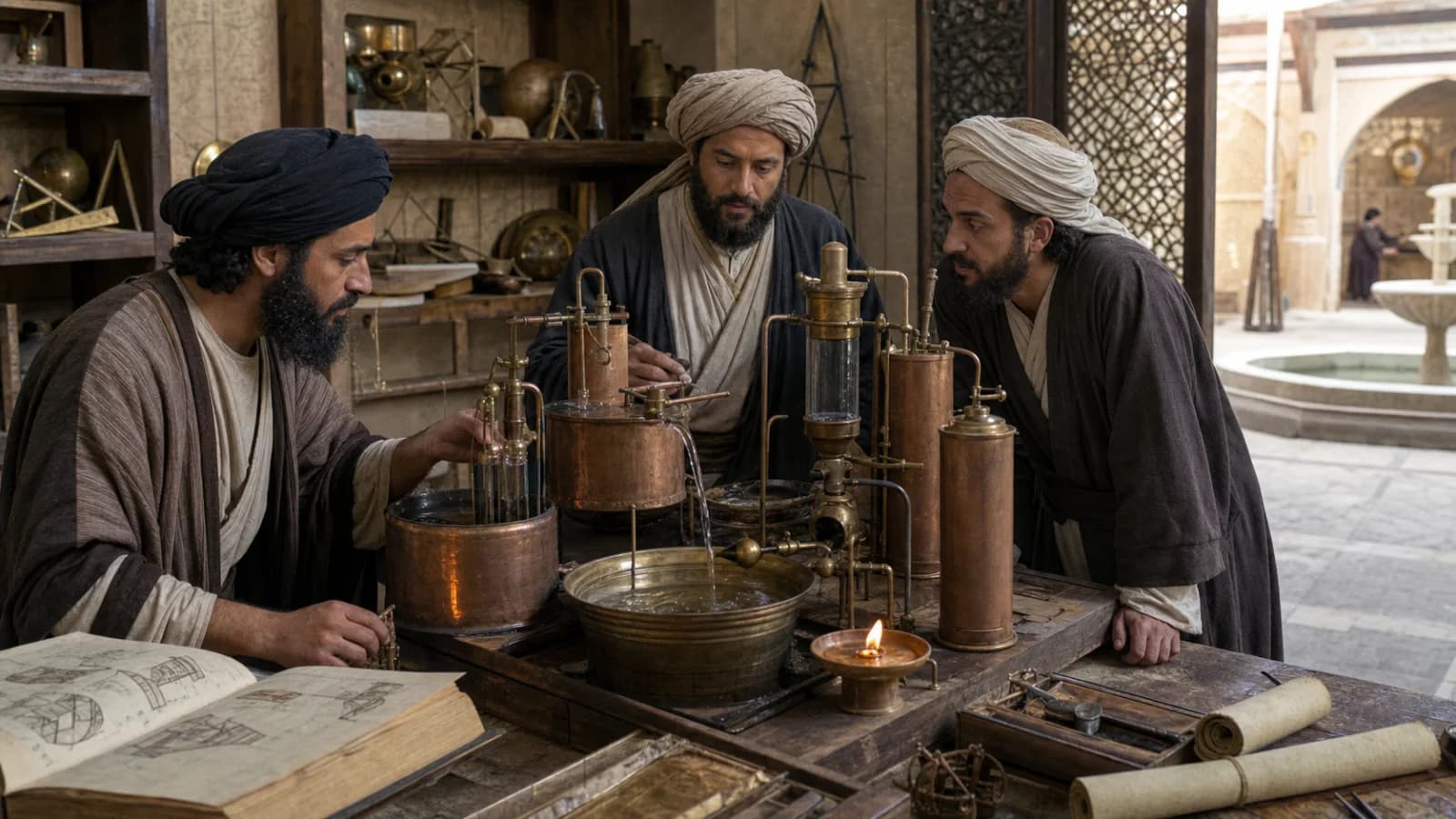
This article uses an original AI-assisted visual reconstruction for educational context. It is not a photograph of the Banu Musa, a House of Wisdom workshop or a surviving device.
What makes a vessel “ingenious”?
Many designs begin with an ordinary action—pouring water or filling a basin—but alter the expected result. A vessel may dispense two liquids separately, stop after a fixed amount, refill itself, or change the shape of a fountain at intervals. The hidden work is done by bent siphons, concentric chambers, floats, air pressure and valves. A tiny change in level can admit air, close an outlet or initiate a siphon, so the device passes from one state to another without a person directly moving every part.
This is why the book interests historians of control as well as historians of spectacle. Some mechanisms use feedback in a precise but limited sense: the level of liquid moves a float, and the float changes an inlet or outlet, which in turn affects the level. That does not make the apparatus a digital computer. It does show designers thinking systematically about automatic regulation centuries before modern control theory gave such behavior a new vocabulary.
A book built from inheritance and experiment
The Banu Musa did not work in isolation. Hydraulic and pneumatic devices had been described in Greek and Hellenistic traditions, and Abbasid scholars gathered, translated and extended knowledge from several regions. The Kitab al-Hiyal includes inherited principles alongside devices that its authors present as their own. Its importance therefore comes from transmission and transformation together: older ideas were reorganized, tested and combined for a new technical and cultural setting.
The surviving witnesses are later than the brothers themselves. A celebrated illustrated copy dated 1209 is associated with the Topkapı Palace Library, and other manuscript witnesses and related scholarship let researchers compare diagrams and wording. A painted schematic should be read cautiously. It can show a pipe passing behind a chamber or distinguish internal from external parts, but its perspective and scale are explanatory rather than photographic.
How to follow one of the designs
First identify every opening to the air. Then trace the liquid path from the highest reservoir to the lowest outlet. Look for a float, plug, narrow nozzle or siphon crest that acts as a threshold. Finally ask what changes after the first discharge and whether the system resets. This method turns a page that looks like an arrangement of decorative jars into a sequence of pressure changes and controlled flows.
Popular accounts sometimes credit the brothers with an exact list of “firsts,” from robots to programmable music. Such labels depend heavily on modern definitions and on how fragmentary evidence is interpreted. The firmer conclusion is more interesting: ninth-century Baghdad supported authors who could describe complex automatic behavior in words and diagrams, and who treated wonder as something that could be designed from ordinary materials and repeatable physical effects.


