Al-Jazari’s Machines: Clocks, Pumps and the Art of Reliable Motion
How al-Jazari turned water, floats, siphons and staged mechanisms into clocks, pumps and automata—and what his illustrated treatise actually preserves.
In 1206, the engineer Badiʿ al-Zaman ibn al-Razzaz al-Jazari completed an illustrated Arabic treatise usually translated as The Book of Knowledge of Ingenious Mechanical Devices. He had worked for the Artuqid rulers of Diyar Bakr in northern Mesopotamia. The book describes fifty devices, among them monumental clocks, fountains, vessels for washing and drinking, pumps and courtly automata. It is not a modern patent catalogue: some machines answered practical needs, others staged sound, motion and surprise for elite audiences.
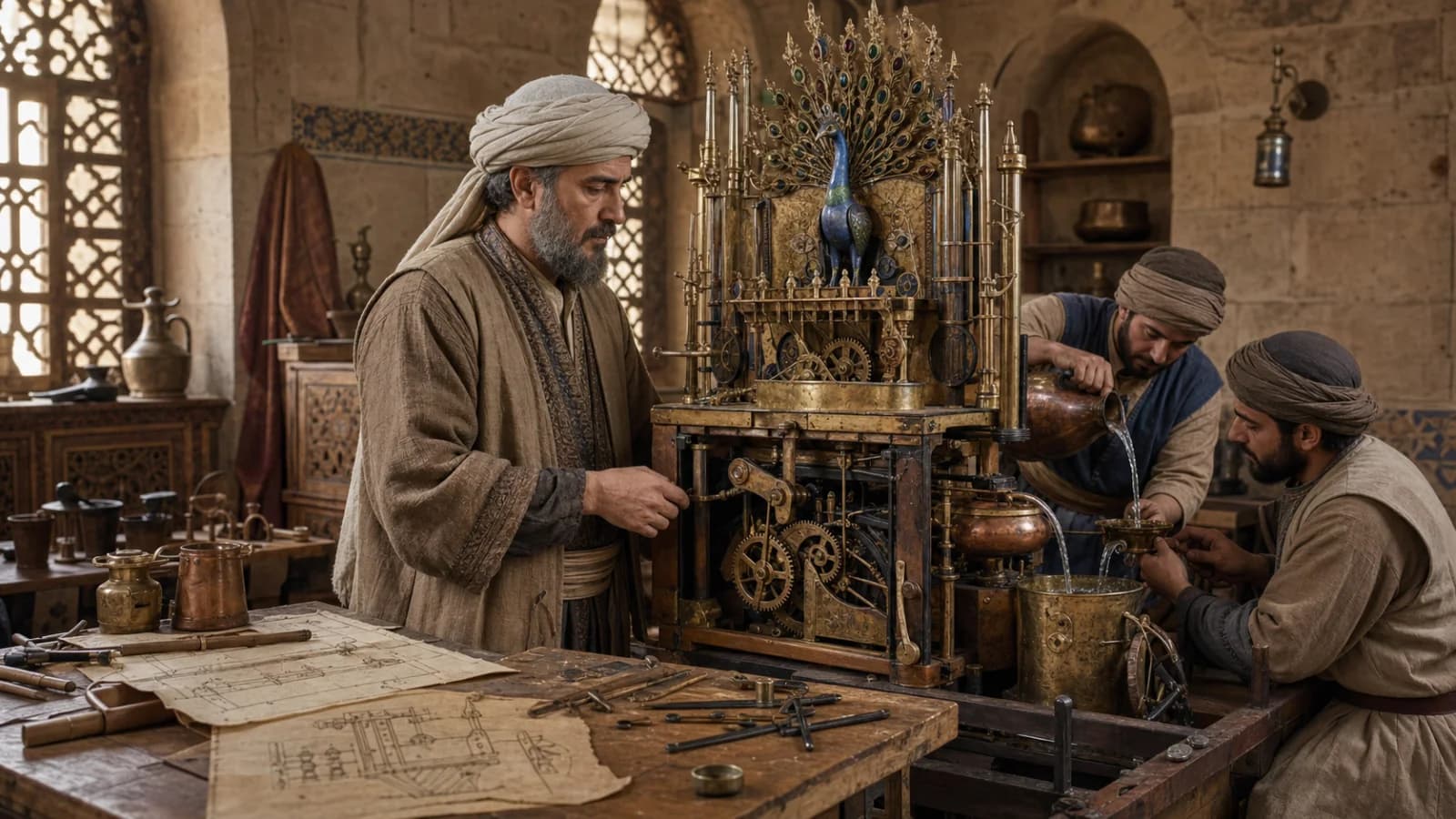
This article uses an original AI-assisted visual reconstruction for educational context. It is not a photograph of al-Jazari, his workshop or a surviving machine.
Mechanisms arranged as a sequence
Al-Jazari’s achievement is easiest to understand by following cause and effect. Water leaves a reservoir at a controlled rate. A float rises or falls, pulling a cord across pulleys. That movement shifts a pointer, opens a door, tips a container or releases a ball. The ball can strike a cymbal and reset another part of the apparatus. Siphons start or stop a flow once a threshold is reached; counterweights return pieces to their initial positions. A single clock could therefore translate slow hydraulic change into several visible and audible events.
The drawings matter because they expose relationships between vessels, pipes, cords and figures rather than presenting only a decorated façade. Yet a manuscript diagram is not the same thing as a surviving working machine. Copies were made after al-Jazari’s lifetime, and individual pages may reflect later painters and scribes. Reconstruction requires reading the instructions, comparing manuscript witnesses and testing whether the proposed sequence can actually operate.
Clocks, pumps and automata
The famous elephant and peacock clocks combined timekeeping with animated display. Other designs served more direct tasks. Al-Jazari described water-raising machinery and a twin-cylinder pump whose reciprocating action was coordinated through mechanical linkage. His hand-washing and serving vessels used concealed floats, valves and siphons to make attendants or birds appear to respond automatically. Calling every such figure a “robot” is catchy but imprecise: these were predetermined mechanical sequences, not machines that sensed the world and made general decisions.
Nor did al-Jazari create engineering from nothing. His work belongs to long Greek, Hellenistic, Persian, Indian and Arabic traditions of hydraulics and automata, while also documenting his own refinements and practical experience. Its historical value lies in the unusually explicit union of craft knowledge, tested motion, illustration and instruction. The book shows engineering as repeated adjustment: dimensions, water pressure, friction and timing all had to cooperate for the spectacle to remain reliable.
How to read a manuscript machine
Begin with the power source, not the ornament. Identify the reservoir and trace the water path. Then locate the regulator, float or tipping vessel that converts flow into measured movement. Follow cords and linkages to the final display, and ask what resets the mechanism. This prevents the painted human and animal figures from hiding the engineering logic. It also makes clear why maintenance was essential: scale in a nozzle, a leaking joint or a swollen wooden part could alter an entire sequence.
Al-Jazari’s pages are compelling because they hold art and technical explanation together. The best response is neither to dismiss their marvels as toys nor to turn the author into a lone inventor of every later machine. They preserve a sophisticated culture of making in which useful work, princely display and close observation of materials occupied the same workshop.


